A jewelry business usually discovers its inventory problem in one of two ways: a bestseller disappears before the replacement order arrives, or cash is trapped in slow-moving colors and sizes. Both problems come from using instinct where a repeatable restocking rule is needed.
Classify Wholesale Jewelry Inventory Before Restocking
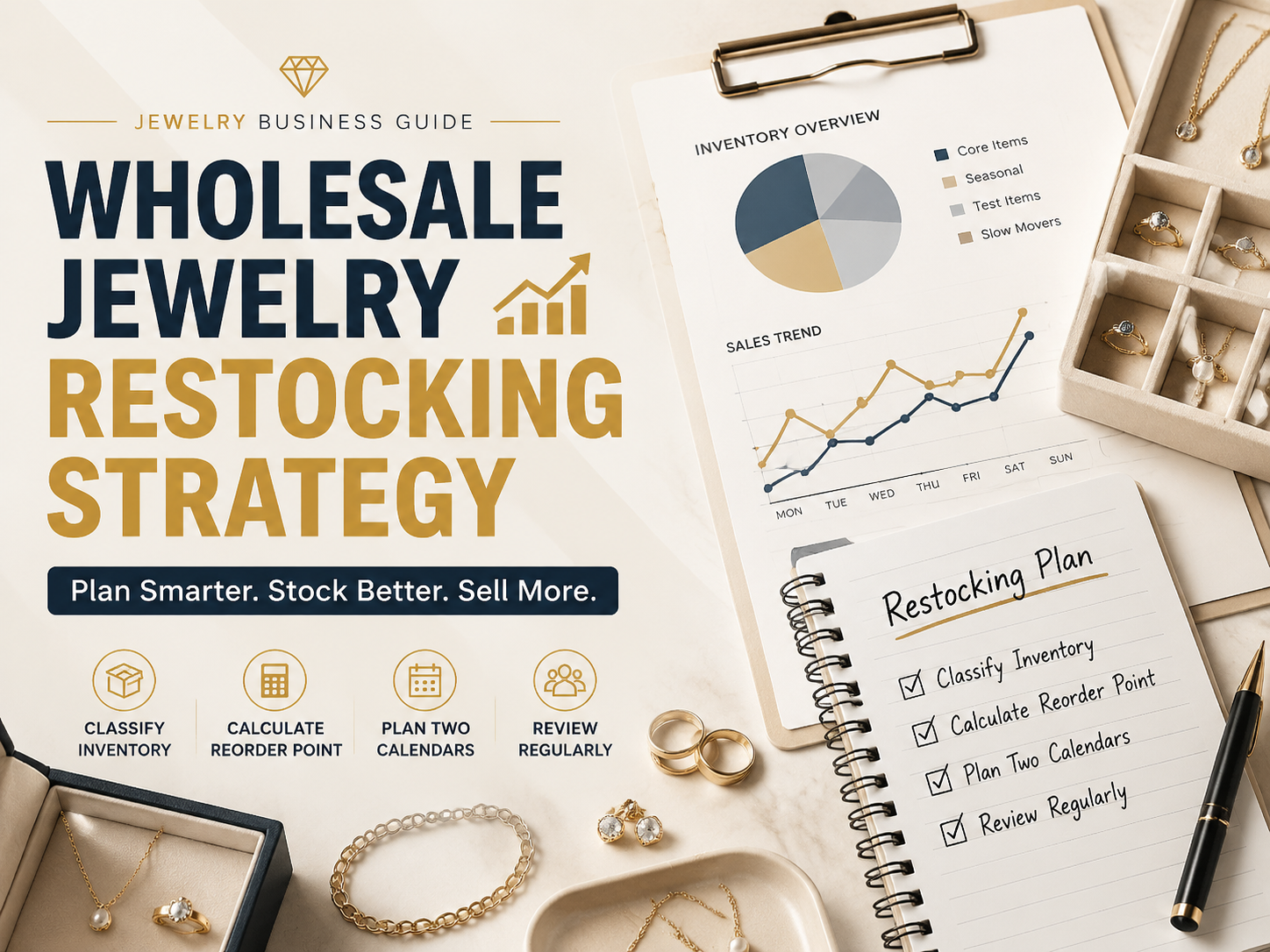
Classify products before setting reorder quantities. Core items are year-round sellers that should rarely be unavailable. Seasonal pieces serve a defined period. Tests are intentionally small bets. Slow movers need an exit plan rather than another purchase order. This classification prevents a dramatic sales week from turning every SKU into a “bestseller.”
Sterling silver basics may justify steady replenishment because the material and designs support repeat sales. Brass fashion jewelry may follow shorter trend cycles. Stainless steel staples often work well as durable core items. Titanium piercing jewelry requires especially careful size, gauge, diameter and thread planning because one style can produce many functional variants.
Calculate the reorder point
A useful starting formula is:
Reorder point = average weekly sales × total replenishment time + safety stock
Total replenishment time begins before production. Include purchase-order confirmation, material preparation, manufacturing, inspection, packaging, freight and receiving. If a chain sells 20 units per week and takes eight weeks to replenish, demand during lead time is roughly 160 units. Safety stock should reflect demand volatility and the consequence of being out of stock.
Do not use the same buffer for every product. A signature necklace advertised in paid campaigns deserves more protection than an experimental charm.
Separate style demand from variant demand
Retail reports often show that a ring design sells well while hiding that two sizes account for most sales. Track the parent design and each variant. Otherwise, the next order repeats the wrong size curve. The same rule applies to chain length, plating color, stone color, piercing gauge and post length.
A supplier can help consolidate production, but it cannot fix a poorly planned assortment. Send reorder data in a stable SKU format and keep product specifications unchanged unless the change is deliberate. Silent changes to chain width, plating shade or packaging can make old and new stock look inconsistent.
Use two calendars
Maintain a customer calendar and a factory calendar. The customer calendar contains launches, promotions, holidays and marketplace events. The factory calendar contains material bookings, production capacity, plating schedules, quality checks and shipping cutoffs. Place orders where the two calendars intersect, not when the shelf already looks empty.
Review inventory in three conversations
Hold a weekly exception review for stockouts and sudden changes, a monthly reorder review for core items, and a quarterly assortment review for discontinuations and new development. Different questions belong in each meeting. Weekly reviews should not redesign the collection; quarterly reviews should not obsess over one unusual day of sales.
Good restocking is deliberately boring. It turns reliable designs into repeat revenue, keeps purchasing decisions explainable and gives the factory enough visibility to reproduce the approved product consistently.