
Have Any Question?
+86 15018094056
Our Working Hours?
7 * 24h
Our Email?
service@evyny.com
+86 15018094056
7 * 24h
service@evyny.com
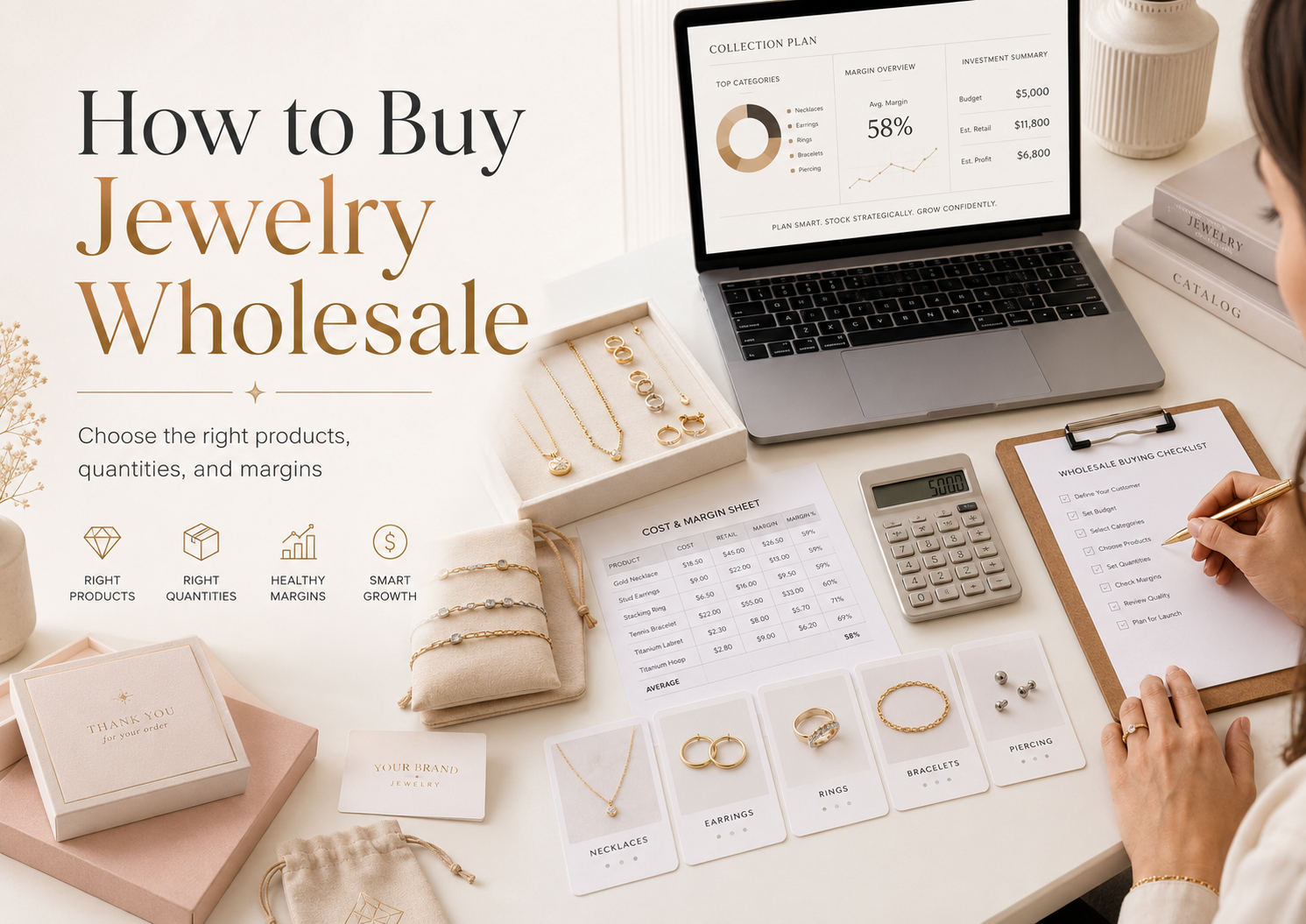
Buying jewelry wholesale is easy. Buying the right jewelry, in the right quantity, with enough margin to reorder is the difficult part. New retailers often begin by collecting attractive products from several suppliers. That creates variety, but not necessarily a sellable collection. A stronger approach starts with the retail customer and works backward.
Decide what your store will be known for before requesting a catalog. A shop selling affordable waterproof basics needs a different material strategy from a boutique selling sterling silver gifts. A piercing studio needs verified titanium specifications, smooth finishing, compatible thread systems, and dependable replacement parts. Write the promise in one sentence, including customer, price range, material and use occasion. That sentence becomes your buying filter.
The jewelry supplier’s unit price is only the first line of the calculation. Landed cost can also include sample development, molds, plating surcharges, branded packaging, inspection, freight, duty, payment fees and an allowance for defects. If a necklace costs $8 at the factory but costs $11.20 by the time it is sale-ready, a retail price based on $8 will create an imaginary margin.
Work backward from a realistic retail price. Subtract payment fees, marketplace commission, fulfillment, marketing, expected discounts, returns and overhead. The amount left must cover landed cost and profit. This calculation quickly shows whether a design belongs in your assortment.
Do not approve a sample only because it looks good in a photograph. Record weight, dimensions, chain length, clasp function, stone security, solder joints, surface finish, logo position and packaging. For plated brass or copper pieces, approve a physical color standard under neutral light. For sterling silver, confirm the agreed alloy and marking. For stainless steel and titanium, request material disclosure and any documentation required for your market.
Use the approved sample and written specification together. A sample without a specification is difficult to reproduce; a specification without a physical standard can leave color and hand-feel open to interpretation.
An opening order should not be an equal quantity of every design. Put more budget into a narrow group of repeatable basics and smaller quantities into trend tests. Limit unnecessary combinations of metal color, size and packaging because every variant splits inventory. For rings, concentrate on a defensible size curve. For chains, test two or three lengths rather than every available length.
Ask the manufacturer which components are shared across the collection. Common clasps, chains, stones or posts can reduce development risk and make reorders faster. An integrated manufacturer can also identify designs that appear different at retail but can share tooling or production processes behind the scenes.
Before paying a deposit, ask what happens if one SKU sells out. Confirm reorder MOQ, production lead time, material availability and whether the approved finish can be matched six months later. A low first-order price has little value if the best seller cannot be replenished.
The best wholesale collection is not the largest one. It is a focused group of products with documented construction, believable retail pricing and a clear replenishment path.

Jinfeng Jewelry Building B, Meibei Industrial Area, Meilong Town, Haifeng County, Shanwei City, Guangdong Province, China
+86 15018094056
service@evyny.com